




Description
Turn Custom GPTs and Prompt Collections Into Portable AI Assets You Control
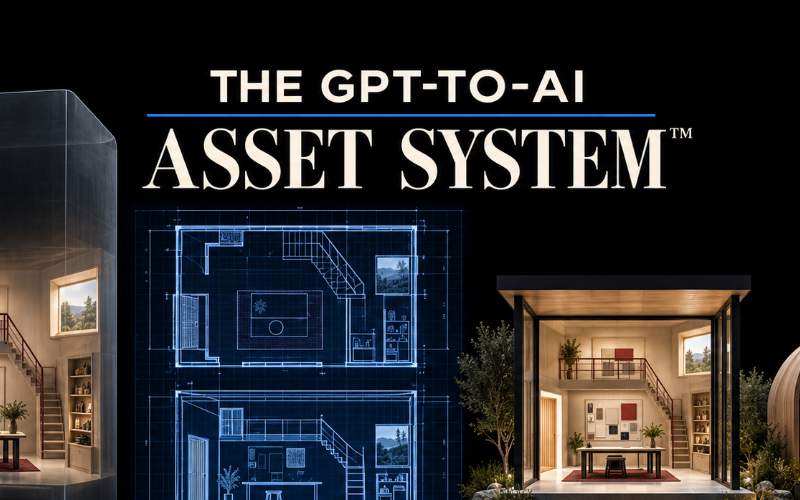
The GPT-to-AI Asset System™ is a practical three-module framework for extracting the valuable thinking from a Custom GPT, unused GPT PLR package or collection of scattered prompts and rebuilding it as a documented AI system that is not dependent on one platform.
Rather than treating the original GPT as the asset, the system helps you preserve what makes it useful: its instructions, knowledge, inputs, workflow, behavioral rules, output structure, examples and technical requirements. These elements are organized into a platform-independent master file that can be adapted for compatible AI platforms and tested to confirm that its essential functionality survived the move.
The process is suitable for working GPTs, unbuilt PLR packages, incomplete prompt collections and authorized AI workflows whose original source files are no longer available.
How the System Works
Get the asset out:
Collect the instructions, knowledge files, conversation starters, examples, supporting documents, capabilities and dependencies that give the original system its value.
Turn it into an AI asset:
Separate the underlying method from the platform and document it as a structured, reusable master file.
Put it to work:
Match the asset’s requirements to an appropriate AI environment, build the new implementation and test its performance.
Module One: Build the GPT Asset Inventory
The first module helps you discover exactly what you have before attempting to improve, migrate or rebuild it. Four starting paths accommodate different situations:
Working Custom GPT:
Extract the complete instructions, conversation starters, knowledge files, examples, enabled capabilities and connected Actions while the original configuration remains accessible.
Unused GPT PLR:
Examine an unbuilt package containing prompts, instructions, reference files, workflows, checklists, graphics or setup material.
Messy or incomplete files:
Gather conflicting versions, partial prompts, scattered notes and supporting documents without prematurely discarding useful material.
Behavior without source files:
Reconstruct an authorized asset from its known purpose, typical inputs, output format, working style and genuine usage examples.
A structured inventory records the asset’s name, purpose, instructions, knowledge, examples, user prompts, capabilities, integrations, supporting material, missing components and the reason it is worth preserving. Everything is then collected into a dedicated working folder without overwriting the originals.
Module Two: Create the AI Asset Master File
The second module identifies the reusable system beneath the original implementation. It begins by defining the asset’s actual job and then maps its operation across seven essential components:
Purpose:
The user it serves, the problem it addresses and the intended result.
Inputs:
The information a user must provide before the AI can complete its task.
Process:
The repeatable sequence the AI follows when reviewing information, making decisions and producing the result.
Knowledge:
The documents, frameworks, templates, examples and reference material required by the workflow.
Rules:
The behaviors the AI must follow and the errors, assumptions or actions it must avoid.
Output:
The required sections, order, format and completion standard for a successful response.
Tools and dependencies:
Any reliance on browsing, file uploads, image generation, code execution, external APIs, databases or persistent instructions.
A quality check then classifies the asset as Ready, Repair or Rethink. This reveals whether the original materials contain a complete working method, need specific gaps repaired or require more substantial redevelopment before implementation.
The Platform-Independent Master File
The completed AI Asset Master File becomes the source of truth for the system. It documents:
The asset name, purpose and intended user.
The core outcome it is designed to produce.
The information users must supply.
The full decision-making and production process.
The knowledge and reference materials it uses.
The rules controlling its behavior.
The required output structure and format.
Necessary tools, capabilities and integrations.
Representative input and desired-output examples.
Open questions and areas requiring further testing.
Platform-specific wording is removed from the master file. Instead of describing where a feature appears inside one service, the document records the underlying requirement. This makes it possible to create different implementations without rewriting or compromising the original asset.
Module Three: Build and Validate the Working Asset
The final module helps you choose the simplest AI environment capable of supporting the asset’s real requirements. It considers who will use the system, whether persistent instructions or knowledge files are needed and whether the workflow depends on browsing, data analysis, code execution or external integrations.
Possible implementations may include a self-contained instruction set, a dedicated AI project, a reusable skill or another platform offering suitable persistent instructions and reference-file support. The master file remains unchanged while a separate copy is adapted for the selected environment.
The Twin Test
The Twin Test verifies whether the rebuilt asset performs the same essential job as the original. Representative prompts test:
Normal use:
Whether the system handles a standard request correctly.
Missing information:
Whether it requests necessary context instead of inventing facts.
Difficult situations:
Whether the defined process remains reliable under less straightforward conditions.
Important rules:
Whether the implementation follows its restrictions when prompted to ignore them.
Output consistency:
Whether results follow the required structure and completion standard.
The original and rebuilt versions can be compared across outcome, process, rules, knowledge use, output and tool performance. If the original was never built, the new implementation is tested directly against the master file. The goal is functional equivalence rather than identical wording.
What You Finish With
GPT Asset Inventory:
A clear record of the original materials, capabilities, dependencies and missing pieces.
Organized source folder:
A working collection containing instructions, knowledge files, examples and supporting documents.
AI Asset Master File:
A platform-independent blueprint documenting how the system is intended to work.
Working implementation:
An adapted version running in a compatible AI environment.
Reusable test prompts:
Representative requests for checking future versions and migrations.
Twin Test results:
A structured evaluation showing whether the implementation preserves the original asset’s essential behavior.
Portable backup:
A paste-anywhere version that provides a practical fallback when the asset does not require advanced integrations.
Quick-reference process:
A condensed summary of the complete inventory, conversion, implementation and validation workflow.
Useful For
Preserving a valuable Custom GPT before changing platforms.
Turning unused GPT PLR into a properly documented AI product.
Organizing prompts, reference files and workflows scattered across multiple folders.
Evaluating whether an AI product contains a genuine repeatable system.
Creating implementations for personal, team, client or customer use.
Maintaining a stable master blueprint while AI platforms and product formats continue to change.
The GPT-to-AI Asset System™ replaces platform dependence with a documented, testable asset-development process. Once the valuable system has been captured in the master file, it can be improved, implemented elsewhere and validated again without rebuilding the underlying logic from the beginning.




Reviews
There are no reviews yet.